
When most people think of a garden, they imagine a large field that has been plowed with long neat rows spaced 3 or 4 feet apart to allow cultivation by a tractor or tiller.
Gardening on such a scale is impossible for city dwellers, considering that residential lot sizes continue to decrease and more and more people are choosing to live in town homes, condominiums, or apartments. Our modern landscapes have little enough room for outdoor leisure in general, not to mention gardening.
Nevertheless, you would be surprised at the amount of vegetables that can be produced in a very small area. When gardening in a small space, there is little need for spacing plants in rows so planting can be more efficient. Also, placing plants in a bed or container reduces the need to walk in or closely around your plants.
This reduces the chances that soils will become compacted and need frequent tilling. And with a little planning, even residents of apartments and condominiums can grow a few vegetables on their patios. Raised-bed and container gardening may also allow those with limited mobility to garden.
There are two common methods for gardening in small spaces: raised bed gardening and container gardening.
One of the reasons that raised bed and container gardening are so productive is that the gardener has control over the soil used in the bed or container. In traditional gardens, soil becomes compacted from tractors, tillers, or people moving across the surface.
Adding components such as organic matter and porous material to raised beds and containers will improve soil structure. An ideal soil for raised beds would consist of equal volumes of garden soil, organic matter (compost, peat moss, composted manure), and porous material (vermiculite or perlite). For containers, soilless potting media is best.
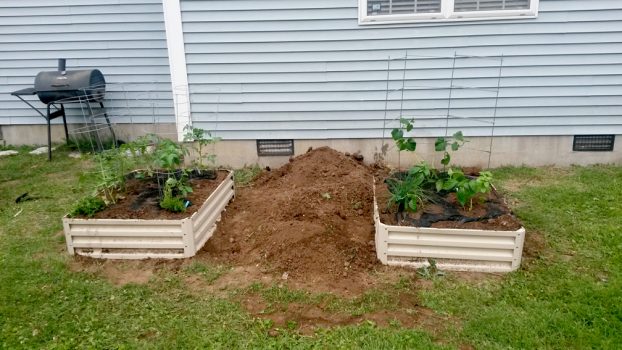
Raised bed gardening has several advantages. Soils in raised beds are usually better drained than the surrounding area so installing raised beds offers a solution for poorly drained sites.
Better root growth from improved soils usually results in higher yields from plants grown in raised beds. Raised beds require less stooping during weeding, watering and other activities.
Raised beds can also be installed in areas that are difficult to garden conventionally such as sites with shallow soil (over rock), steep slopes, or poor soil quality.
The garden beds are usually raised off the ground surface to a height of at least 6 to 8 inches. A frame to support the soil may be constructed from wood, stone, concrete block or brick, even old rubber tires, or the gardener may prefer to simply mound the soil without a rigid structure.
The bed size will vary according to the gardener’s needs and the space available. Beds are typically constructed no more than 4 feet wide since this width allows for an easy reach into the bed from either side.
Even if you live in an apartment or condominium with only a balcony, patio or walkway available for gardening, you can still enjoy many of the rewards of growing your own vegetables.
Lack of space for a traditional garden is not the only reason to try container gardening. Switching to container gardens can be one solution to a traditional garden site that is unsuitable because of poor drainage, problems with soil-borne organisms, too much shade or too much sun. Container gardening is also one example of assistance gardening that may be suitable for people with disabilities or limited mobility. Many container-grown vegetables also have ornamental value and can enhance your home. You can grow vegetables in just about any container that will hold soil, is large enough to support the crop when it is fully-grown and has drainage holes.
Focusing on the small scale and adaptability of these small space gardens shows you that almost anyone can grow some kind of garden. People of different sizes, people with different experience in growing things, people with disabilities, older and younger people – all can manage some kind of garden. Just decide which kind you want and design it so that the gardener will be able to work in it. Have teenagers build gardens for elderly people to manage. Grow gardens with lots of scents and textures for the visually challenged. Build gardens up on tables or sawhorses so that wheelchairs will fit underneath. Get out in the sunshine and GROW!
For more information about raised beds and container gardening, log on to http://bit.ly/SmallGardening or call the Extension Office and ask for Gardening in Small Spaces publication. Contact the Franklin County Extension Office by phone, 502-695-9035 or email [email protected].
Educational programs of the Kentucky Cooperative Extension Service serve all people regardless of economic or social status and will not discriminate on the basis of race, color, ethnic origin, national origin, creed, religion, political belief, sex, sexual orientation, gender identity, gender expression, pregnancy, marital status, genetic information, age, veteran status, or physical or mental disability.
[“source=state-journal.”]