

Home Secretary Sajid Javid says a British woman who fled to Syria aged 15 to join Islamic State could be stopped from returning if he decides she poses a threat to the UK. One option, Mr Javid told the Times, was to strip Shamima Begum of her British citizenship. But under international law, it’s not possible to render a person stateless, so she would have to become a national of another country for that to be legal.
Another option, as our home affairs correspondent Dominic Casciani explains,is a Temporary Exclusion Order, a controversial legal tool which bars a British citizen from returning home until they have agreed to investigation, monitoring and, if required, deradicalisation.
Ms Begum’s family have appealed for the pregnant teenager to be shown mercy. She fled with two other girls from east London in 2015 – hear what people there think of her desire to return.
‘Lawless act’?
President Trump is to declare a national emergency in order to fund his border wall, having been refused the sums he wants by the US Congress. What does that mean? Well, the power is supposed to be used in a time of crisis to divert money from existing military or disaster relief budgets. President Trump says the flow of migrants over the Mexican border is a crisis, but others disagree – read more on that argument.
Senior Democrats have accused him of committing a “gross abuse of power” and a “lawless act”. Others view it less seriously, pointing out that presidents declare emergencies surprisingly often. Will it mean the wall gets built? Maybe, but there’ll be lots of legal and political challenges first.
Anthony Zurcher, our North America reporter, says this is a battle over more than just the wall – it’s over who gets to set the political agenda for the next two years of the Trump presidency. If the latest development is anything to go by, Mr Trump looks like he’ll try to go around Congress, not through it, to get his way.
Blow to PM
Theresa May suffered another Commons defeat on Thursday after MPs voted against a motion endorsing her negotiating strategy with Brussels. The defeat has no legal force and Downing Street said it would not change the Mrs May’s approach, but our political editor Laura Kuenssberg says it’s still a blow. Just when the PM wanted to show the EU that she could hold her party together, a fifth of her MPs refused to support her.
And as our Europe editor Katya Adler explains, Mrs May’s struggles won’t make the EU more likely to give her a helping hand. Without evidence of a comfortable majority of MPs solidly behind her efforts to renegotiate, why give ground, the logic goes, because it might be for nothing?
Quiz of the week
Find out if you’ve kept up to speed.
Chernobyl: The end of a three-decade experiment
By Victoria Gill, BBC science correspondent
“This place is more than half of my life,” says Gennady Laptev. The broad-shouldered Ukrainian scientist is smiling wistfully as we stand on the now dry ground of what was Chernobyl nuclear power plant’s cooling pond. “I was only 25 when I started my work here as a liquidator. Now, I’m almost 60.” There were thousands of liquidators – workers who came here as part of the mammoth, dangerous clean-up operation following the 1986 explosion. The worst nuclear accident in history.
Read the full article
What the papers say
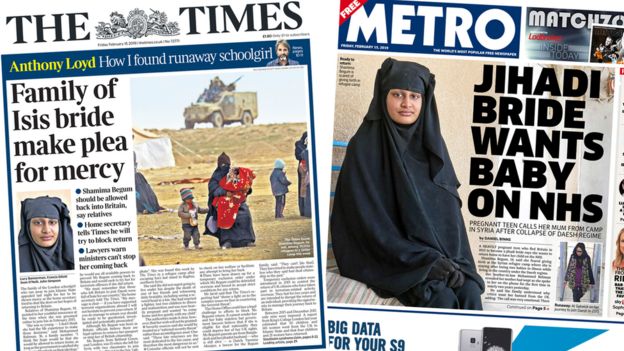
There’s widespread coverage of the case of Shamima Begum. The Sun calls the 19-year-old “shameless” and “sickening” and says she must never set foot in Britain again. The Daily Telegraph says forgiveness is “out of the question”. But the Daily Mail says it accepts “with deep reluctance” that she is a British citizen and is our responsibility. The Times, who found the teenager in a refugee camp in Syria, has spoken to relatives who say she was young and innocent when she joined Islamic State and should now be allowed home. Elsewhere, “May’s Brexit deal in tatters… again” is the headline in the Daily Mirror. The i says the latest defeat has fuelled doubts over whether the prime minister could get any deal through Parliament. Finally, on the end of the Airbus A380, it was a “technological marvel”, says the Financial Times, but the superjumbo has now “succumbed” to hard business facts.
[“source=bbc”]